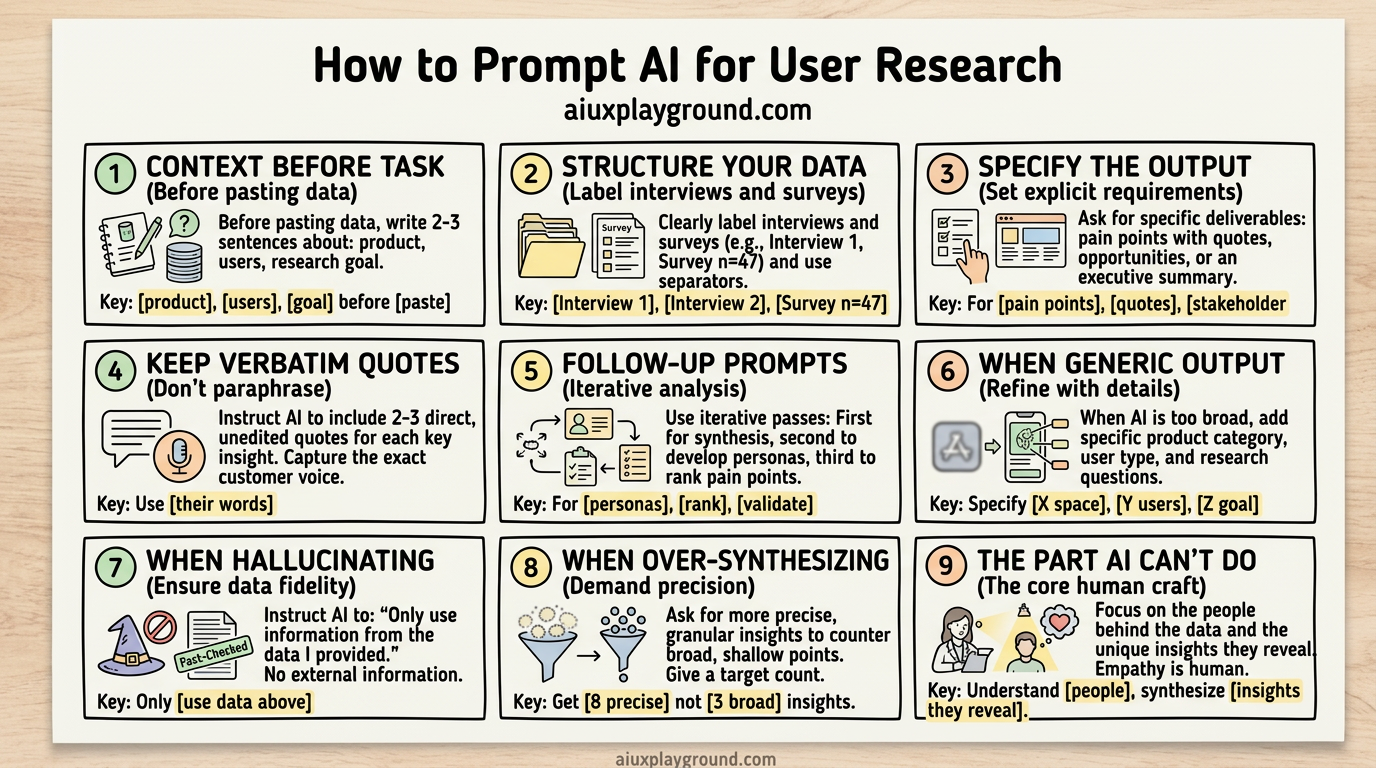
Survey Analysis Framework
Analyze survey data to extract design insights, identify patterns, and generate actionable recommendations.

Prompt
Analyze this survey data and extract design insights:

[Paste survey data: responses, quantitative data, open-ended responses]

Survey Context:
- Survey purpose: [describe]
- Number of respondents: [number]
- Target audience: [describe]

Provide:

1. Quantitative Analysis
   - Key metrics and statistics
   - Response distributions
   - Significant correlations
   - Demographic breakdowns

2. Qualitative Analysis
   - Themes from open-ended responses
   - Common phrases or language
   - Sentiment analysis
   - Notable quotes

3. Key Findings
   - Top 5-7 most important findings
   - Surprising discoveries
   - Confirmed assumptions
   - Disproven assumptions

4. User Segments
   - Distinct user groups identified
   - Characteristics of each segment
   - Needs and preferences by segment
   - Design implications for each segment

5. Pain Points & Frustrations
   - Most common pain points
   - Severity of each pain point
   - Frequency of mentions
   - Context of pain points

6. Opportunities
   - Design opportunities identified
   - Quick wins
   - Long-term improvements
   - Potential impact

7. Design Recommendations
   - Specific design recommendations
   - Prioritized by impact and feasibility
   - Success metrics
   - Next steps

Format as a comprehensive survey analysis report with data visualizations and actionable recommendations.
How to use
- 1Gather your survey data: Collect survey responses, quantitative data, and open-ended responses
- 2Replace [Paste survey data] with your survey data. Format quantitative data as tables or lists, and open-ended responses as text
- 3Replace [describe], [number], and [describe] with your survey context. Example: "Survey purpose: User satisfaction with checkout flow. Respondents: 250. Target audience: E-commerce customers."
- 4If you have survey questions: Paste the survey questions. Say "Survey questions: [paste questions]"
- 5Paste the modified prompt into your preferred AI tool, like ChatGPT or Claude
- 6Review the analysis report: Check quantitative analysis, qualitative themes, key findings, and user segments
- 7Focus on design opportunities: Review opportunities and design recommendations prioritized by impact
- 8Ask for specific insights: Request "Focus on quantitative findings" or "Analyze open-ended responses in depth"
- 9Export to design tools: Copy insights and recommendations to your design documentation
- 10Use for design decisions: Apply the design recommendations to inform your design work
Pro Tips
- • Clean the file first with Survey Data Quality & Open-End Coder. Do not analyze junk rows.
- • Format quantitative data: Present survey results as tables or bullet points with numbers for easier analysis
- • Include open-ended responses: Paste all open-ended responses so AI can identify themes and patterns
- • Specify respondent count: Mention "250 respondents" so AI can provide context about sample size
- • Request prioritization: Ask "Prioritize design recommendations by impact and feasibility" for actionable insights
- • For large surveys: If you have hundreds of responses, consider analyzing by question: "Analyze responses to question 3"