User Interview Guide
Simple generative interview outline: objectives, question sets, probes. Need a timed session with tasks or a concept? Use Moderated Discussion Guide Generator, Usability Test Script, or Concept Test Protocol instead.

Prompt
Create a comprehensive user interview guide for [research topic]. Include:

1. Interview Objectives
   - Research questions
   - What you want to learn
   - Key assumptions to validate
   - Success criteria

2. Participant Profile
   - Target user characteristics
   - Screening criteria
   - Recruitment approach

3. Interview Structure
   - Introduction (5 min)
   - Warm-up questions
   - Main interview (30-45 min)
   - Wrap-up (5 min)

4. Question Sets
   - Background questions
   - Current behavior questions
   - Pain point questions
   - Needs and goals questions
   - Feature/concept questions
   - Closing questions

5. Probing Techniques
   - Follow-up prompts
   - "Tell me more about..."
   - "Can you give me an example?"
   - "Why is that important to you?"

6. Interview Tips
   - Do's and don'ts
   - How to handle silence
   - Managing time
   - Note-taking approach

7. Analysis Framework
   - How to synthesize findings
   - Key themes to look for
   - Output format

Format as a ready-to-use interview guide with all questions and prompts.
How to use
- 1If the session includes tasks, a prototype, or a concept, use Moderated Discussion Guide Generator or Usability Test Script / Concept Test Protocol instead of this outline.
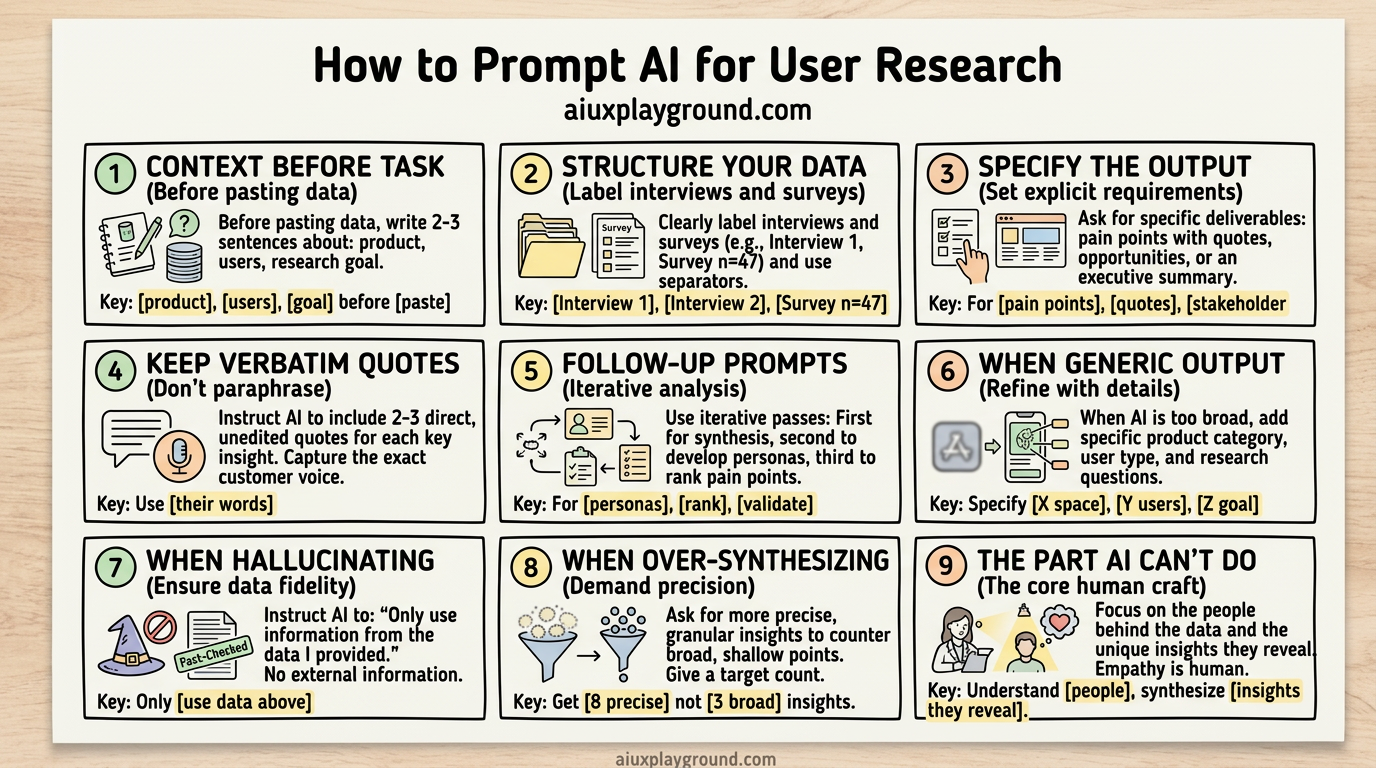
- 2Replace [research topic] with your specific research goal (e.g., "understanding how users manage projects" or "validating a new feature concept")
- 3Add context before the prompt: Describe your product, research goals, and what you want to learn. Example: "We're building a project management tool. Research goal: Understand how product managers currently manage tasks. Want to learn: Pain points, tools they use, workflow patterns."
- 4If you have user personas: Paste persona details. Say "Create interview questions for this persona: [persona]"
- 5If you have assumptions to validate: List your assumptions. Say "Validate these assumptions: [list]. Create questions to test them."
- 6Paste the modified prompt into your preferred AI tool, like ChatGPT or Claude
- 7Review the interview guide: Check question flow, coverage of topics, and probing techniques
- 8Refine questions: Ask "Make question 3 less leading" or "Add more questions about [specific topic]" or "Reorder questions for better flow"
- 9Export to your research tool: Copy to Notion, Dovetail, or print for in-person interviews
Pro Tips
- • Specify interview length: Mention "45-minute interview" or "30-minute quick interviews" to adjust question count
- • Include follow-up prompts: Ask AI to add probing questions like "Tell me more about that" or "Can you give me an example?"
- • Avoid leading questions: Review the guide and ask AI to "rewrite any leading questions" to keep them neutral
- • Test the guide: Run through questions yourself to ensure they flow well and make sense
- • Save as template: Reuse the structure for future interviews by asking "Use the same structure but for [new topic]"