Interview Batch Report
First-pass report across several interview notes. For one session use Session Debrief From Transcript. For a full study use Affinity Mapping Assistant, then Research Insight Statement Writer. Same outline as Mixed-Source Research Synthesis, interview-only.

Prompt
Use this only as a first-pass report across several interviews. If this is one transcript, stop and run Session Debrief From Transcript. To cluster and rank themes with coverage counts, use Affinity Mapping Assistant, then Research Insight Statement Writer.

Synthesize the following user interview notes into a structured first-pass report:

[Paste interview notes, transcripts, or key quotes]

Provide:

1. Interview Summary
   - Number of interviews
   - Key themes across interviews
   - Notable patterns or contradictions
   - Interview quality assessment

2. Key Insights
   - Top 5-7 most important insights
   - Supporting quotes or evidence
   - Frequency of themes
   - Surprising or unexpected findings

3. User Pain Points
   - Pain points identified (ranked by severity)
   - Emotional impact of each pain point
   - Context where pain points occur
   - Quotes illustrating each pain point

4. User Needs & Goals
   - Primary goals users are trying to achieve
   - Unmet needs
   - Motivations and drivers
   - Success criteria from user perspective

5. Behavioral Patterns
   - How users currently solve problems
   - Workarounds and hacks
   - Tools and methods they use
   - Decision-making processes

6. Opportunities
   - Design opportunities based on insights
   - Quick wins vs. long-term improvements
   - Potential impact of addressing each opportunity
   - Feasibility considerations

7. Design Recommendations
   - Specific design recommendations
   - Prioritized action items
   - Success metrics for each recommendation
   - Next steps for validation

Format as a structured synthesis report ready for design team and stakeholders.
How to use
- 1Prefer Session Debrief From Transcript after each session, then Affinity Mapping Assistant and Research Insight Statement Writer for the study. Use this prompt only if you need a single first-pass report from several interviews.
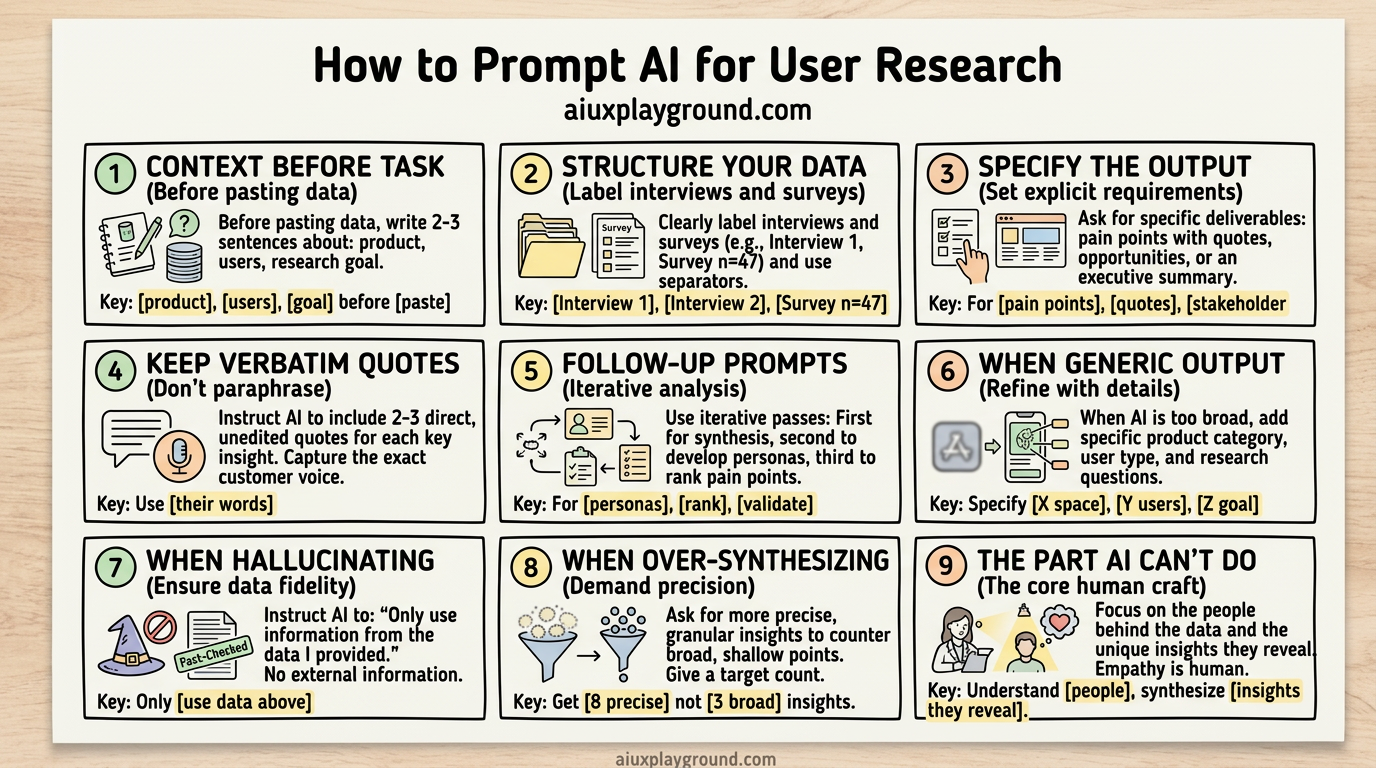
- 2Collect your interview notes: Gather interview transcripts, notes, or key quotes from user interviews
- 3Replace [Paste interview notes, transcripts, or key quotes] with your organized interview data. Format: "Interview 1: [notes]" "Interview 2: [notes]" etc.
- 4Add context before the prompt: Describe your research goals. Example: "We conducted 10 user interviews about our checkout flow. Goal: Understand pain points and identify improvements."
- 5If you have participant info: Mention participant count. Say "We interviewed [X] participants"
- 6Paste the modified prompt into your preferred AI tool, like ChatGPT or Claude (preferably with longer context if you have many interviews)
- 7Review the synthesis report: Check key insights, pain points, opportunities, and design recommendations
- 8Prioritize recommendations: Focus on opportunities ranked by impact and feasibility
- 9Ask for refinements: Request "Focus on [specific theme]" or "Prioritize pain points by frequency"
- 10Export to design tools: Copy insights to Figma, Miro, or your design documentation
- 11Share with stakeholders: Use the synthesis report to align team on user needs and design direction
Pro Tips
- • Include participant quotes: Paste verbatim quotes so insights feel authentic and evidence-based
- • Specify interview count: Mention "10 interviews" so AI can provide context about sample size
- • For large datasets: If you have many interviews, consider synthesizing in batches: "Synthesize interviews 1-5" then "Synthesize interviews 6-10"
- • Request prioritization: Ask "Rank opportunities by impact and feasibility" for actionable recommendations
- • Save as template: Reuse synthesis structure for future interview synthesis
- • Canonical path: Session Debrief From Transcript → Affinity Mapping Assistant → Research Insight Statement Writer → Research Readout Builder.